When Leica announced the Noctilux-M 75mm f/1.25 ASPH in November 2017, the US price was $12,795. For one lens. With manual focus. Nine years later, a clean used copy still sells for around ten thousand dollars, and the one that sold on Aperture.market went for $10,250. That is not a typo, and it is not only the red dot. Here is what goes into that number, and how to tell whether the lens is for you.
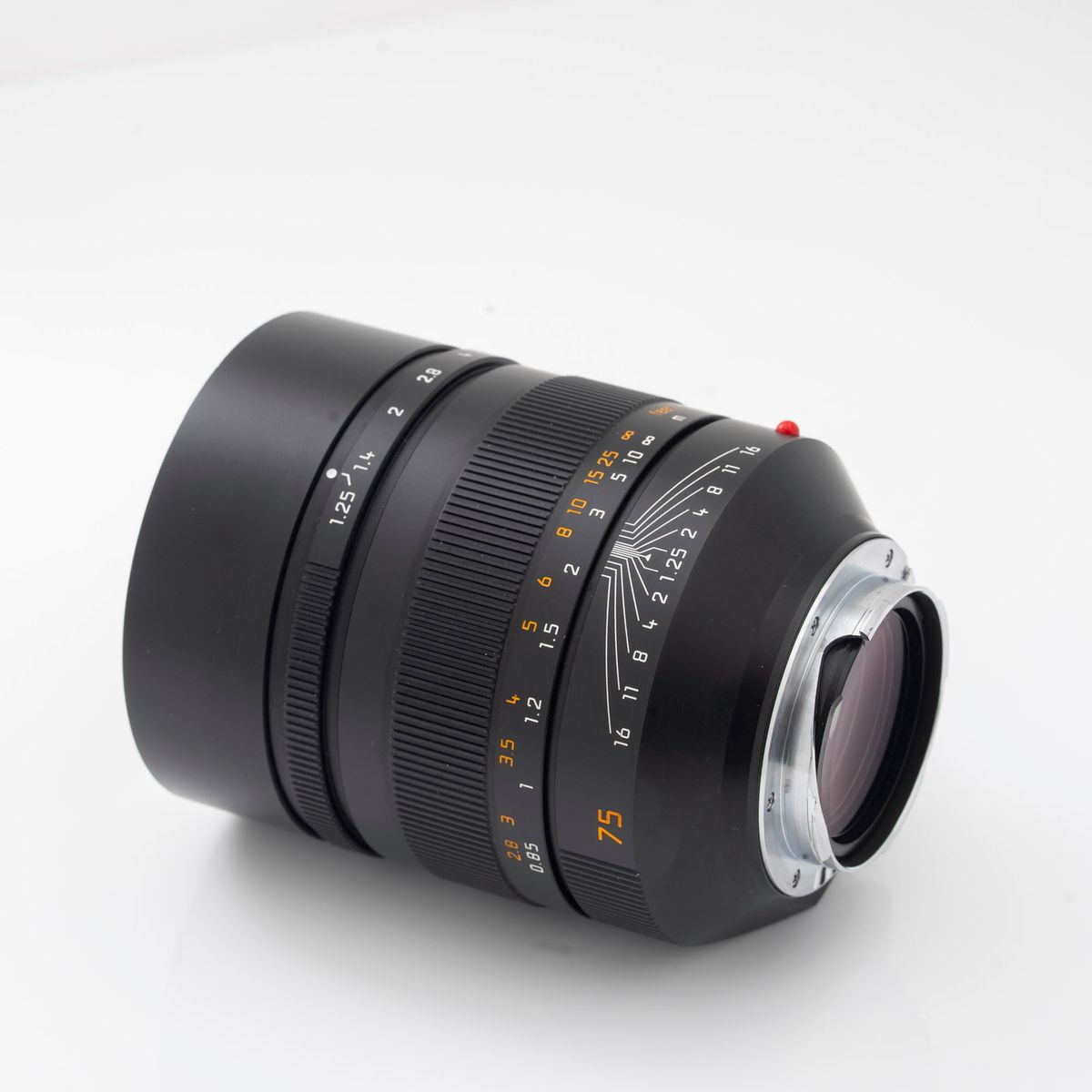
The short answer
Worth it if…
- Portraits at f/1.25 are the look you are after
- You shoot with an electronic viewfinder or live view
- You do not mind carrying a kilogram of glass
- You buy used, so most of the money comes back when you sell
Skip it if…
- You want a small M kit you carry all day
- You focus only through the optical rangefinder
- A 75mm APO-Summicron or a 90mm would do the job
What it is
"Noctilux" is Leica's name for its fastest lenses, the ones built to shoot in almost no light. For fifty years that meant a 50mm. The 75mm f/1.25 was the first Noctilux at a portrait focal length, and at close range its depth of field is thinner than that of the famous 50mm f/0.95: focus on an eye and the ear is already soft.
| Noctilux-M 75mm f/1.25 ASPH | |
|---|---|
| Announced | November 2017 |
| Price when new (US) | $12,795 |
| Optics | 9 elements in 6 groups, 2 aspherical, floating element |
| Aperture | f/1.25 to f/16, 11 blades |
| Weight | About 1,055 g (2.3 lb) |
| Size | About 91 mm long, 74 mm wide |
| Filter | E67 |
| Hood | Built in, twists out and locks |
| In the box | Tripod adapter, caps, leather case |
Where the money goes
The glass. Making a 75mm lens this fast and still sharp wide open takes large elements of exotic glass, two of them ground to aspherical shapes. Big aspherical elements are slow and expensive to make to the accuracy a lens like this needs.
The floating element. One group moves on its own as you focus, which keeps the lens sharp up close. It is the right way to build a portrait lens and it adds parts, tolerances and assembly time.
Small numbers, built by hand. Leica makes these in small batches in Germany, assembled and adjusted by a person. Nothing about it benefits from mass production, so nothing about the cost gets spread thin.
And yes, the name. Part of the price is that it says Leica on the front and Noctilux on the barrel. That same fact is why it holds its value, which matters when you work out what it really costs to own.
"The fair way to price a Noctilux is not what you pay for it. It is what you pay, minus what you get back."
What it actually costs to own
A lens that cost $12,795 new and sells for about $10,000 years later has lost very little. Buy a used one at a fair price, look after it, and you can usually sell it for close to what you paid. Few pieces of camera gear behave like that. Our Noctilux 75 value page shows what recorded copies have gone for.
The catch: focusing it
At f/1.25 and 75mm, the zone of sharp focus is a few millimetres deep at portrait distance. The optical rangefinder in an M was not designed for that, and even a well-adjusted camera will miss some frames. Leica itself points buyers to the electronic viewfinder, and most owners use the Visoflex, live view, or mount the lens on an SL body with the M adapter. If you only ever use the rangefinder patch, expect to stop down or accept misses.
It is also heavy. At just over a kilogram it weighs more than most M bodies, which is why Leica includes a tripod adapter.
Buying one used: what to check
- Focus accuracy on your camera. Test it wide open at 1 to 2 metres before you pay. Small errors that hide on other lenses show here.
- Glass. Shine a light through from both ends. Look for haze, scratches and cleaning marks on the big front element.
- Hood and focus feel. The built-in hood should twist out and lock firmly. Focus should be smooth and even from end to end.
- 6-bit coding and mount. Check the mount for wear and that the camera recognises the lens.
- Box, case and tripod adapter. A complete set sells for more. The condition guide explains how wear is graded.
Our take
The Noctilux 75 is expensive because it is hard to make and because people keep wanting it. If its look is what you want, there is no cheaper lens that does the same thing on an M. If you are not sure, a 75mm APO-Summicron is smaller, lighter, far easier to focus and thousands less. Our 35mm lens guide shows how the same trade between speed, size and price plays out across Leica's other lens lines.
When one comes up for sale it will be in the lens listings on Aperture.market, sold by its owner with zero commission. On a lens at this price, that is a four-figure difference from a marketplace that takes a percentage.