Leica made 2,000 of them, announced in June 2021, and five years on a clean one still sells for more than it cost new. The M10-R Black Paint takes the same pictures as a regular M10-R that costs thousands less. So why do people keep paying the premium? A few have passed through Aperture.market, and the answer is a mix of history, scarcity and one unusual idea: a camera that is designed to wear out on the outside.
The short answer
Buy the Black Paint if…
- You want a digital M you will keep and use for years
- You like the idea of a camera that shows its mileage
- You care about resale: it has held its price far better than the regular M10 models
- You prefer a Leica with no red dot on the front
Buy a standard M10-R if…
- You only care about the files (they are identical)
- Worn paint would bother you instead of pleasing you
- You would rather put the difference into a lens
What it actually is
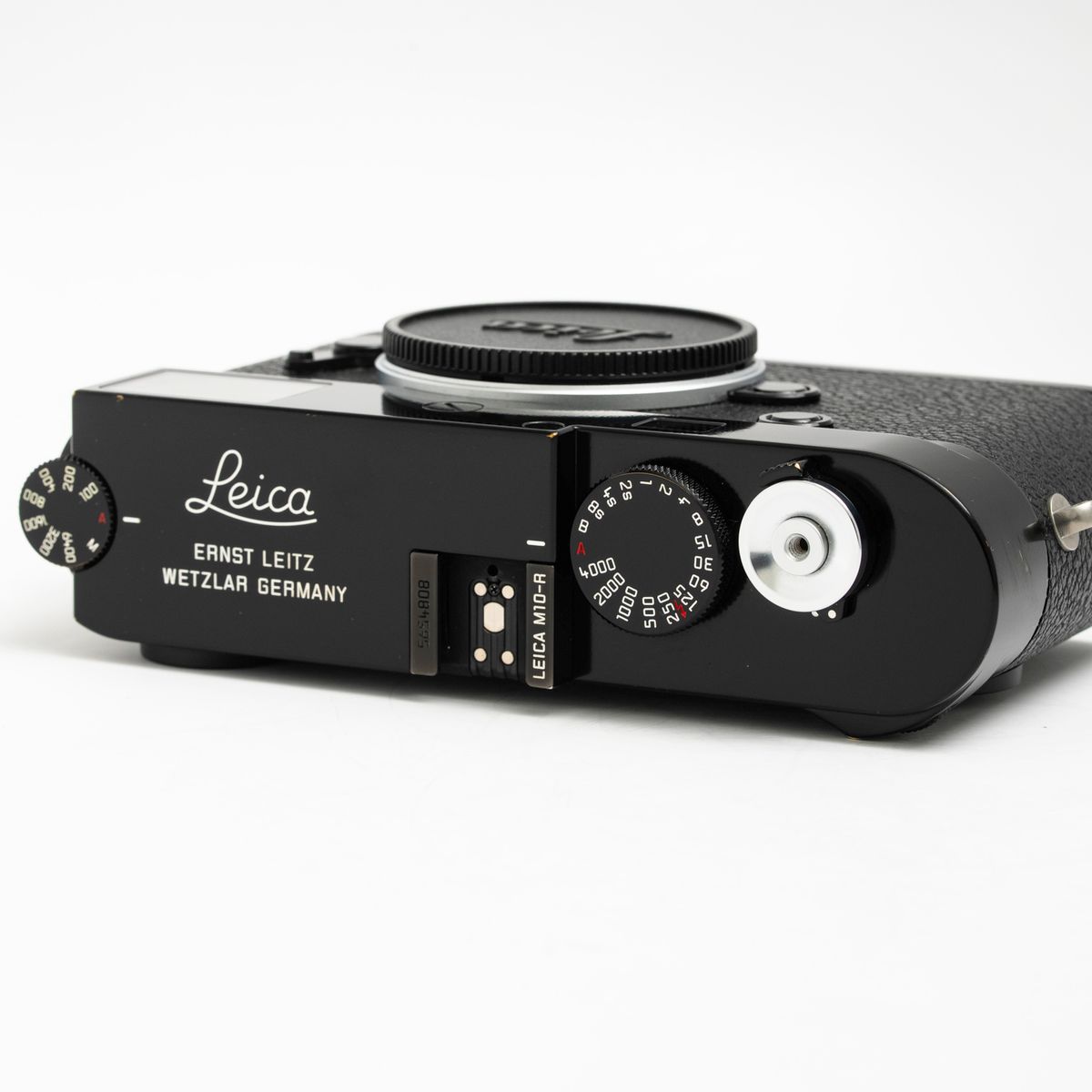
Inside, it is a standard M10-R: the 40MP full-frame sensor, the same quiet shutter, the same rangefinder, the same battery. Leica changed only the outside. Regular M10 bodies are finished in black chrome or silver chrome, both of which are hard, matte and built to stay looking new. This one is coated in glossy black paint, the first painted finish Leica offered on any M10-generation camera.
| M10-R (standard) | M10-R Black Paint | |
|---|---|---|
| Sensor | 40MP full frame | Same |
| Finish | Black chrome or silver chrome, matte | Glossy black paint |
| Front of camera | Red Leica dot | No red dot |
| Top plate | Plain | Leica script and "Ernst Leitz Wetzlar" engraving |
| Dials and shutter button | Standard | Cross-knurled dials, silver chrome release |
| How it ages | Stays much the same | Paint wears to show brass |
| Production | Regular model | 2,000 worldwide |
| Price when new (US) | $8,995 | $9,295 |
Why black paint means so much to Leica people
In the film era, most Leica M cameras left the factory in silver chrome. A much smaller number were painted black, usually for working photographers who wanted a camera that drew less attention. Those cameras got used hard. The paint rubbed through at the corners, the strap lugs and wherever a thumb rested, and the brass underneath started to show.
That wear, called brassing, became part of the legend. A black paint M2 or M3 with honest brassing looks like a camera with a working life behind it, and original examples are among the most valuable Leicas there are. So when Leica put real paint on a current digital M, it was offering something its customers had been asking for: a new camera that would, in time, look like the old ones.
"Every other camera you own looks worse as it ages. This one is supposed to look better."
Scarcity, and a price that barely moved
Two thousand cameras is a small run for a model people want to shoot with every day. Leica also priced it only $300 above the standard M10-R at launch, so plenty went to people who planned to shoot with them, not only to collectors.
The used market shows it. The two M10-R Black Paint bodies that sold on Aperture.market went for $9,750 and $9,850, both in excellent condition, both above the $9,295 they cost new in 2021. Dealers commonly ask over $10,000. A standard M10-R in the same condition sells for thousands less; our M10-R value page tracks what both versions go for.
Almost no digital camera does this. Digital bodies normally lose value as soon as the next model arrives, and the M11 arrived in 2022. The Black Paint shrugged it off, because nobody buys one for the spec sheet.
The no-red-dot look
Part of the appeal is simply how it looks. Without the red dot, and with the old-style script engraved on top, the camera is quieter from the front and more traditional from above. It is the same recipe Leica uses for its "P" models, combined with a finish those never had. Plenty of buyers will tell you it is the best-looking digital M so far, and they are not hard to believe.
Buying one used: what to check
Brassing on a Black Paint is expected and does not hurt the price much, as long as it is honest wear on edges and corners. What you are checking for is damage, not patina.
- Dents and deep scratches are damage, and they do cost money. Smooth, even wear does not.
- Rear screen: scratches here are not charming. Look closely.
- Rangefinder alignment: focus on something far away and something close. Our rangefinder checklist walks through it.
- Sensor: shoot a plain wall at f/16 and look for spots or marks.
- Box and papers: with a limited edition these matter more than usual. A complete set sells faster and for more.
If you are deciding between M10 versions in general, our M10 vs M10-P vs M10-R guide covers the differences that affect your pictures, and the condition guide explains how we grade wear.
Our take
The M10-R Black Paint is popular because it is the rare limited edition that makes sense to use. It costs more than a standard M10-R, but so far owners have got that money back when they sell, and in the meantime they carry a camera that gets more personal every year. If the brassing idea leaves you cold, buy the standard body and a better lens. If it makes you smile, this is the M10 to own.
They do not come up often. When one does, it will be in the Leica listings on Aperture.market, sold directly by its owner with zero commission. If you have one to sell, the listing writer will draft the description for you.