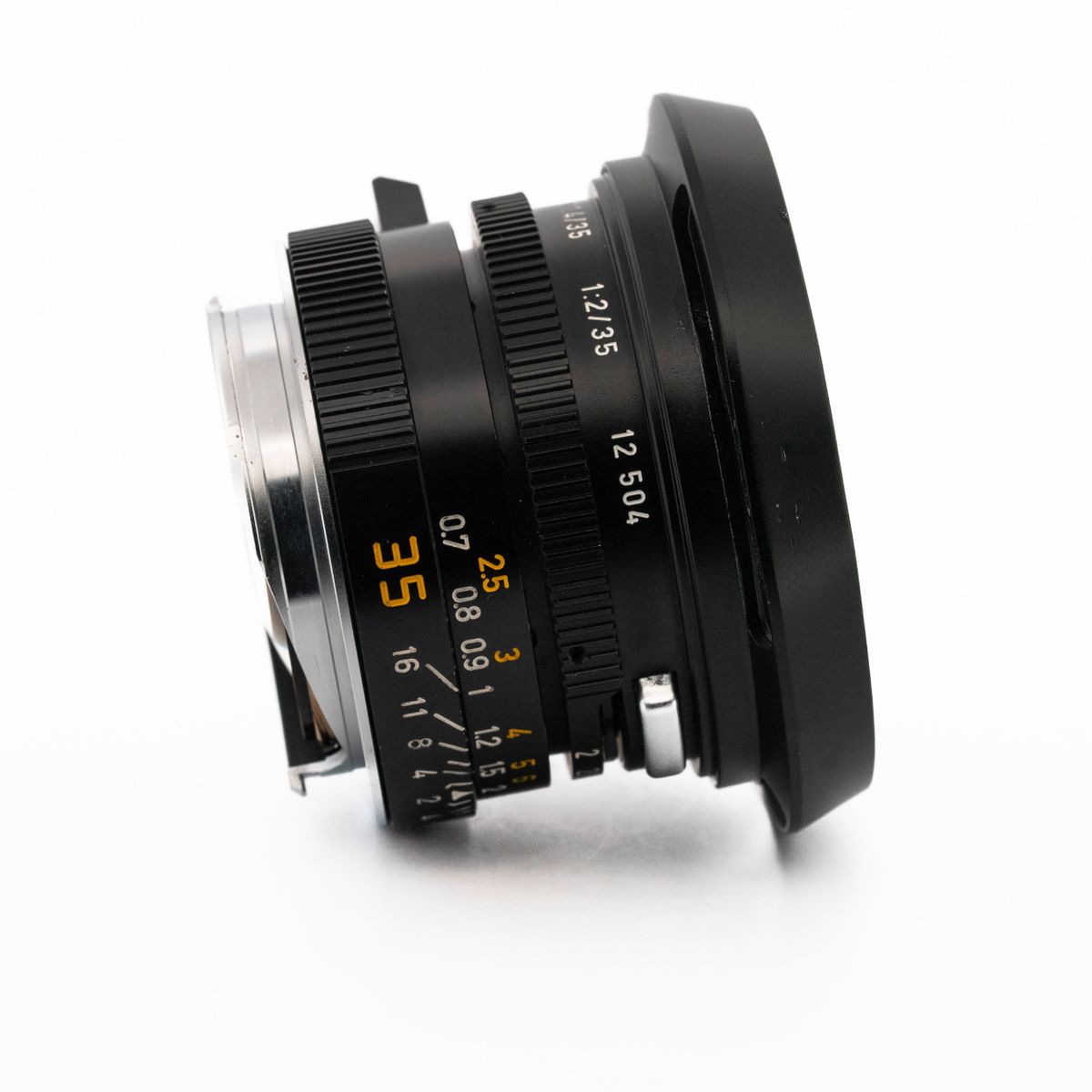
Ask for a "King of Bokeh" in a camera shop and you will be handed a small, plain-looking 35mm lens that went out of production in the 1990s. It has no aspherical elements and no special coatings by today's standards. It also sells for about $3,000, as much as the newer 35mm Summicron ASPH. Here is what it is, why it has the nickname, and whether it deserves it.
The short answer
Buy one if…
- You want a tiny 35mm with a gentle, classic look
- You shoot film, or want less clinical files from a digital M
- You value a lens that keeps its price
Skip it if…
- You want the sharpest corners wide open
- You expect a dramatic blur machine (it is f/2, not f/1.4)
- You would rather have a newer lens with less wear risk
Which lens is it, exactly?
Leica has made the 35mm Summicron-M in several versions since 1958. The "King of Bokeh" is the fourth, sold from 1979 until the ASPH version replaced it in the 1990s. It is the last 35mm Summicron made without aspherical elements, and it uses seven glass elements, so you will also hear it called the "seven element" or simply "v4".
| What it is | How to spot it | |
|---|---|---|
| Version 1 (1958) | The "8-element", the collector's favourite | Often with an infinity lock; some with "goggles" for the M3 |
| Versions 2 and 3 | 6-element designs | Shorter, simpler barrels |
| Version 4 (1979) | 7 elements, the "King of Bokeh" | Very compact, focus tab, 39mm filter |
| ASPH (late 1990s on) | Aspherical, sharper wide open | "ASPH." engraved on the front |
Version 4 was made in both Canada and Germany, and you will see either engraved on the barrel. Optically they are the same lens. The very earliest ones have a differently shaped focus tab that collectors call the "tiger paw", and a small number were finished in silver chrome; both sell for more than the ordinary black version.
Where the name came from
Not from Leica. The nickname comes from a single reviewer, years ago, who praised the way this lens draws the out-of-focus parts of a picture, and dealers have repeated it ever since. "Bokeh" is the Japanese-derived word for the quality of that blur, not the amount of it.
That distinction matters. At f/2 on a 35mm lens you will never get a background that melts away completely. What the version 4 does is move from sharp to soft smoothly, without harsh edges or busy double lines in the background. It is a quiet quality, and you notice it most in ordinary pictures: a person at a table, a street scene with depth.
"It is not the lens with the most blur. It is the lens whose blur never gets in the way."
How it compares with the modern ASPH
The ASPH is the better lens on a test chart. It is sharper wide open, especially at the edges, and it has more contrast. The version 4 is a touch softer at f/2, lower in contrast and slightly warm, and it sharpens up well by f/4. On a 40 or 60MP digital M, some people prefer exactly that. It is also smaller and lighter than the ASPH, which on an M is half the point.
Prices tell you how the market feels. On Aperture.market a version 4 sold for $3,000 and a 35mm Summicron ASPH also sold for $3,000. A lens that left production three decades ago costs the same as its successor. Our 35mm Summicron value page lists what each version has gone for, and the 35mm buying guide compares the Summicron with the Summilux and Summaron.
Buying one used: what to check
- Haze. The common fault on lenses this age. Shine a phone light through from the back and look for a milky veil. Light haze can be cleaned by a technician; budget for it.
- Front element marks. The coatings are softer than modern ones. Fine cleaning marks are common and lower the price.
- Focus tab and feel. The tab should be intact and the focus smooth, not gritty or loose.
- Aperture ring. Clicks should be clean at every stop, with no oil on the blades.
- 6-bit coding. Many have been coded during a Leica service so a digital M recognises them. It is a plus, not a requirement.
Our condition guide explains how we grade lenses, haze included.
Our take
The name oversells it and the lens is still worth owning. Buy a version 4 for its size, its gentle rendering and the fact that you are unlikely to lose money on it. Do not buy it expecting f/1.4 blur. If you want the cleanest files from a high-resolution body, the ASPH is the more sensible choice at the same price.
Both turn up in the Leica listings on Aperture.market, sold directly by photographers with zero commission. If you are selling one, say which version it is and where it was made in the title: buyers search for exactly that.